
Introduction
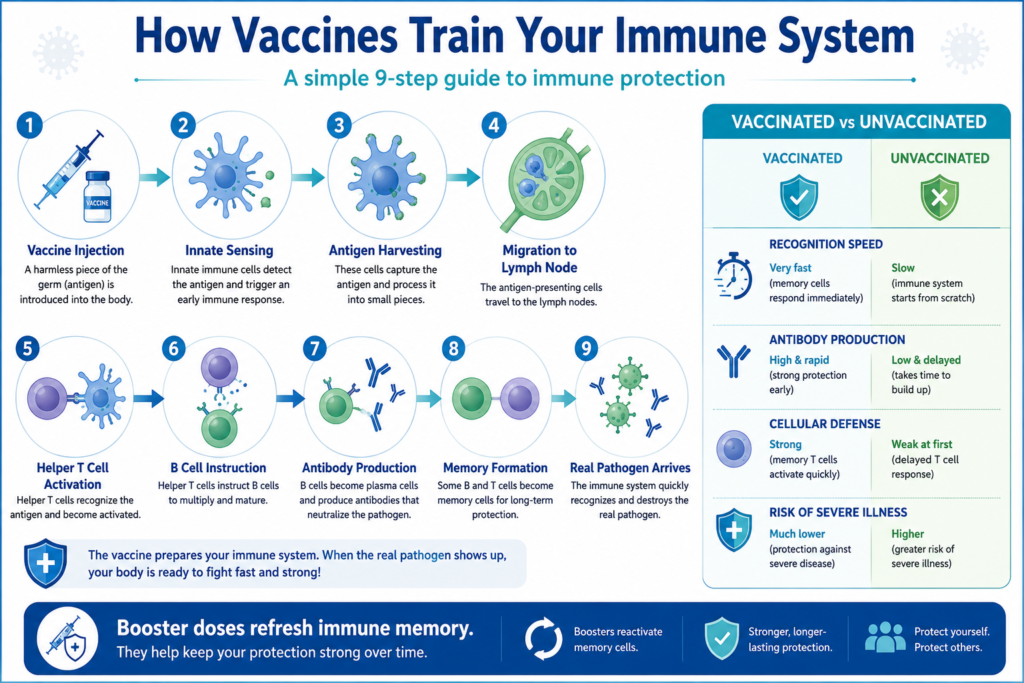
Vaccines don’t work by chance — they provide targeted training that teaches your immune system to recognize and defeat harmful viruses and bacteria. At VaccinationCentre.com we explain how vaccines build long-lasting protection in everyday language, using the latest immunology basics. Read on for a simple, nine-step guide to how your body learns to fight pathogens after vaccination.
- Vaccine delivery: a safe training session
A vaccine delivers a harmless version or piece of a pathogen (an antigen), or the genetic instructions (like mRNA) to temporarily make that piece. This harmless “preview” shows your immune system what the real enemy looks like without causing disease. Keywords: how vaccines work, vaccine antigen. - Innate sensing: the first alarm
Local sentinel cells detect the vaccine and trigger a mild inflammatory response. Chemical signals recruit immune cells to the injection site. Minor side effects such as soreness or low-grade fever are normal signs the immune system is responding. Keywords: vaccine side effects, immune response. - Antigen harvesting: dendritic cells collect evidence
Dendritic cells act as scouts. They capture vaccine antigens, process them into smaller fragments, and display these fragments on their surface like identification photos. Keywords: dendritic cells, antigen presentation. - Migration to the lymph node: the immune command center
Loaded dendritic cells travel through lymphatic vessels to nearby lymph nodes — hubs where immune cells meet, compare notes, and coordinate action. Keywords: lymph nodes, lymphatic system. - Helper T cell activation: turning on coordination
Inside the lymph node, dendritic cells present antigens to naive Helper T cells. When a T cell recognizes the antigen, it activates, multiplies, and becomes the conductor of the immune response. Keywords: helper T cells, T cell activation. - B cell instruction: design and expansion
Activated Helper T cells find B cells that recognize the same antigen and provide signals that trigger B cell expansion and specialization. B cells prepare to become antibody-producing factories. Keywords: B cell activation, antibody formation. - Antibody production: targeted neutralizers
B cells differentiate into plasma cells and release antibodies — Y-shaped proteins that bind to the pathogen, block infection, and tag invaders for destruction. This antibody surge is the main barrier that prevents disease. Keywords: antibodies, neutralizing antibodies. - Memory formation: long-term protection
Some activated B and T cells become long-lived memory cells. These cells persist for months to years and allow the immune system to react faster and stronger during future exposures. Keywords: immune memory, long-term immunity. - The real pathogen arrives: the immune test
If you encounter the actual pathogen later, memory cells cut down the “lag time” needed to mount a defense. Vaccinated people typically experience rapid antibody production, strong T cell responses, and a much lower risk of severe illness. Keywords: vaccinated vs unvaccinated, breakthrough infection.
| Feature | Unvaccinated | Vaccinated |
|---|---|---|
| Recognition speed | Slow. The body must identify the threat from scratch. | Rapid. Memory cells recognize the threat quickly. |
| Antibody response | Delayed. It takes days to weeks to build enough defenses. | Immediate and robust. The body mounts a faster, stronger response. |
| Cellular defense | Weak early T cell activity. | Swift cytotoxic T cell expansion. |
| Risk of severe disease | Higher without vaccine training. | Much lower after vaccination. |
Why booster doses matter
Antibody levels and some memory can wane over time. Booster doses act like refresher courses — reactivating memory cells, improving antibody quality, and broadening protection against variants. Follow local health guidance on booster schedules. Keywords: vaccine boosters, booster dose importance.
Practical takeaways
- Vaccines safely prepare your immune system to recognize and neutralize pathogens.
- Mild reactions after vaccination are normal signs of immune activation.
- Boosters help maintain strong protection over time.
- Staying up to date with recommended vaccines reduces your risk of severe disease.
Keywords: vaccine safety, stay up to date.

Leave a Reply