
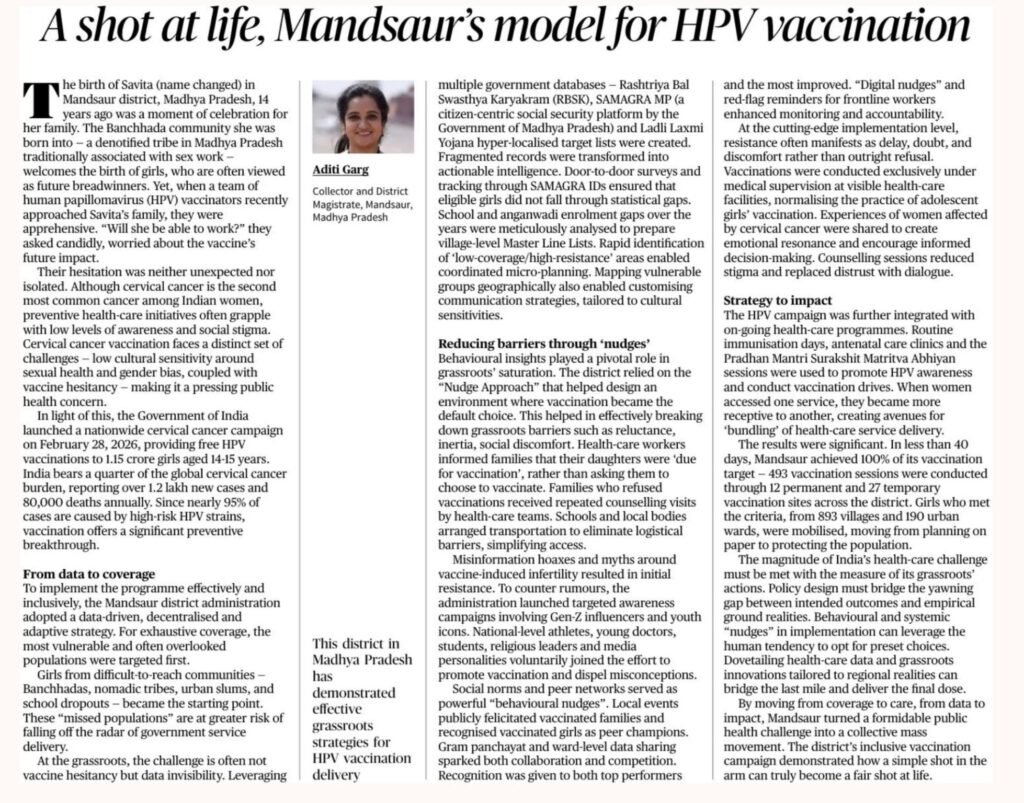
The secret wasn’t coercion; it was psychology. Officials deployed a “nudge” strategy — reframing vaccination not as a request, but as a default. Health workers didn’t ask parents to opt in; they simply informed them their daughters were “due” for the jab. No debate, no friction — just logistics: where transport was lacking, schools and local bodies filled the gap.
Myths (infertility, chiefly) were tackled head-on — not through lectures, but through credibility: Gen Z influencers, local sporting heroes, and trusted doctors carried the message. Vaccinated girls, meanwhile, were celebrated publicly as “peer champions” — turning social proof into momentum.
Behind it all: relentless, unglamorous monitoring. Digital reminders. Tight integration with existing immunisation and antenatal systems. No heroics — just discipline.
The result? 893 villages. 190 urban wards. 100% coverage. Forty days flat.
The lesson, surely, is this: behavioural design — not mandates — may be public health’s most underused lever.
(Written by Aditi Garg, District Collector, Mandsaur. Source: The Hindu.)
#PublicHealth #HPV #HPVVaccination #Vaccination #NudgeTheory

Leave a Reply